To donate, please scan on this QR code. |
PLATFORM
CAMPAIGN PLATFORM
● HEALTHCARE REVIVAL : M Y WAY
● TERM LIM ITS : DRAIN THE SWAM P
● AN AM ERICA FIRST ECONOM IC PLAN FOR TEXAS AND THE NATION
● AN AM ERICA-FIRST FOREIGN POLICY FOR A SAFER W ORLD
● CONTINUING TO KEEP A SECURED BORDER, PROTECT TEXAS
● CONSTITUTION RIGHTS & FREEDOM S
● GOD IS PRO-LIFE
● ENERGY DOM INANCE FOR TEXAS & AM ERICA
● SUPPORT RURAL PROSPERITY, FARM ERS & RANCHERS
● LAW & JUSTICE REFORM : SUPPORTING LAW ENFORCEM ENT & PUBLIC SAFETY
● SUPPORTI NG AM ERICAN INNOVATI ON & M ANUFACTU RING - KEEPING TE XAS #1
● STANDING FOR FAM ILY VALUES & PARENTAL RIGHTS
● A TEXAS-FIRST PLAN FOR EDUCATION REFORM
● ELECTION INTEGRITY THAT TEXANS CAN TRUST
● HONORING SERVICE, SUPPORTING SECURITY: A TEXAS PLAN FOR OUR MILITARY & VETERANS
● SUPPORTING TEXAS W ORKERS: SKILLED TRADERS, SERVICE INDUSTRIES & EVERYDAY HEROES
HEALTHCARE REVIVAL : MY WAY
I am the only candidate in the 2026 U.S. Senate primary with hands-on healthcare
management experience , having led primary care clinics, wound care & hyperbaric
medicine clinics, a hospitalist group, while supporting patients through the peak of
COVID with drive-through clinics, telemedicine, and testing operations, including
managing patient house calls operations, worked in hospital based and surgical center
systems. For the past five plus years, I have been a co-owner of a Texas-based home
health and hospice company serving 73 counties in West and North Texas , giving
me firsthand insight into the challenges facing rural and urban healthcare alike. I
know what works, what is broken, and how federal regulations, insurance practices,
and underfunded reimbursement systems hurt patients and providers — and I am
running to revive healthcare in Texas, put control back in the hands of patients
and providers, and deliver real solutions for affordable, accessible, and
high-quality care across our state .
A. REVIVAL OF THE TEXAS RURAL HOSPITALS
🏥 Texas Rural Hospitals: Crisis and Need for Action
📍 What’s Happened in Texas
According to recent research, Texas has seen about 25 rural hospital closures in the
last 20 years — more than any other state.
leaving communities without emergency care and basic services.
📊 Hospitals at Risk Right Now
Despite the closures already occurring, the crisis isn’t over — many more facilities
remain vulnerable:
🔹 Texas has roughly 156 rural hospitals today.
🔹 108 have reduced or lost critical services.
🔹 87 are at risk of closure if conditions don’t improve.
🔹 22 are at immediate risk of shutting down soon.
This means more than half of rural hospitals in Texas are facing financial stress that
could lead to closure without targeted intervention.
🧠 Why This Matters
Rural hospitals are not just buildings — they are lifelines for people and communities :
✔ They provide emergency services, often the only option within driving distance.
✔ They offer maternity care, chronic disease management, and preventive medicine.
✔ When a rural hospital shuts down, mortality rates rise up to 8.7% because
residents must travel farther for care.
Communities lose jobs, economic anchors, and local clinics when hospitals close —
all at a time when rural Texans already face physician shortages and higher uninsured
rates.
🛠 My Plan for Healthcare Revival
If elected U.S. Senator from Texas, I will champion a comprehensive Healthcare
Revival Agenda focused on revitalizing rural healthcare systems so every Texan can
get care close to home.
🔹 1) Stabilize and Protect Rural Hospitals
sustainably.
🔹 2) Invest in Workforce and Training
repayment and tax credits.
🔹 3) Telehealth and Infrastructure Upgrades
care remotely.
🔹 4) Targeted Public Health Programs
health, chronic disease management, and elder care.
📣 Why This Matters for Texas
Rural Texans — veterans, farmers, families — deserve access to quality healthcare
without hours of travel . Strengthening rural hospitals means protecting lives,
supporting local economies, and building a healthier future for every community.
B. Fixing the Private Insurance & Medicare Advantage Reimbursement Crisis
⚠ The Core Problem
Across Texas, healthcare providers are facing a serious and growing crisis — Medicare
Advantage (MA) plans and private insurance companies are paying far less than the
true cost of care, even as operational and staffing expenses have nearly doubled over
the last several years.
While healthcare costs rise due to:
reimbursement rates from Medicare Advantage plans and private insurers have failed
to keep pace — creating an unsustainable financial gap for providers and facilities.
This gap is now one of the leading threats to patient access, provider sustainability,
and rural healthcare survival in Texas.
📉 How Low Reimbursement Impacts the Entire Care Continuum
Primary Care Physicians & Providers
visit than the actual cost of providing care.
reduce effective reimbursement.
practice closures — especially in rural and underserved areas.
Specialty Care Visits
chronically ill patients.
Hospital Care
traditional Medicare rates, despite higher administrative requirements.
readiness, or uncompensated care burdens.
Home Health Care
with MA plans frequently paying below the cost of care delivery.
fragile.
Nursing Care & Long-Term Care Facilities
cover staffing ratios, wage competition, or regulatory requirements.
Rehabilitation & LTAC (Long-Term Acute Care) Facilities
structures that undervalue complex recovery services.
💰 The Reality: Costs Are Rising Faster Than Payments
Today, many Texas healthcare providers face a stark reality:
sector.
increases have remained flat or minimal — or declined after accounting for
inflation and administrative barriers.
This mismatch is pushing providers to the brink and limiting access for patients who
already have insurance .
🗳 My Plan as Texas’s Next U.S. Senator
If elected, I will make fair reimbursement from Medicare Advantage plans and
private insurers a top federal priority, because insurance coverage is meaningless if
providers can’t afford to deliver care.
1. Enforce Payment Fairness and Transparency
I will push for federal standards that:
on actual cost data;
independent providers.
2. Medicare Advantage Accountability Reform
I will advocate for:
same services;
reimbursement.
3. Protect Provider Networks and Patient Access
Low reimbursement forces providers to exit insurance networks. I will work to:
with inadequate provider access;
plans.
4. Strengthen Negotiating Power for Providers
I will support policies that:
home-based providers to negotiate collectively with large insurance companies;
insurance corporations.
5. Tie Reimbursement to Workforce Sustainability
Healthcare reimbursement must reflect real-world staffing needs. I will push for:
short-term cost cutting.
🌟 Why This Matters for Texans
This is not a partisan issue — it’s a patient access issue.
When insurance companies underpay:
As Texas’s next U.S. Senator, I will fight to ensure insurance works for patients and
providers — not just insurance companies. Fair reimbursement is essential to reviving
healthcare access, strengthening our workforce, and keeping care close to home for
every Texan.
C. Ending the Hospice Cap Penalty: Putting Patients Before Bureaucracy
⚠ The Problem: A Regulation That Punishes Compassionate Care
Under current federal healthcare regulations, hospice agencies are subject to a
Medicare hospice “aggregate cap.” This cap limits the total amount a hospice
provider may receive per patient over a set period.
When a hospice patient lives longer than the government’s projected timeframe, the
hospice agency is often required to return previously paid funds to the Centers for
Medicare & Medicaid Services (CMS) — even though the care was medically
appropriate, lawful, and already delivered.
In plain terms:
stable, and alive.
This policy creates a perverse and dangerous incentive in our healthcare system.
🚨 Why This Regulation Is Wrong
1. It Penalizes Providers for Prolonging Life
Hospice care is meant to:
But under the current cap system, providers are effectively punished for doing their
job too well — for stabilizing patients, managing symptoms, and preventing
unnecessary hospitalizations.
No healthcare system should penalize care that extends comfort, dignity, or life.
2. It Forces Financial Risk onto Hospice Agencies
Hospice agencies:
Yet CMS requires agencies to repay funds years later, often after audits, creating:
3. It Discourages Access to Hospice Care
This regulation leads to unintended but harmful consequences:
longer,
denied hospice access,
This is rationing by regulation, not by medical judgment.
4. It Undermines the Ethical Foundation of Hospice Care
Hospice care is about:
A policy that ties payment to whether a patient dies “on time” is ethically
indefensible.
🗳 My Plan to Fix This as a U.S. Senator from Texas
As Texas’s next U.S. Senator, I will fight to modernize hospice regulations so they
reflect medical reality, ethical care, and patient-centered values.
1. Reform or Eliminate the Hospice Aggregate Cap
I will introduce and support legislation to:
stays;
after the fact.
2. Replace Time-Based Caps with Clinical Accountability
I will push CMS to:
stay;
3. Protect Hospices from Retroactive Clawbacks
I will advocate for:
access;
4. Expand Access for Non-Cancer and Chronic Illness Patients
Current rules disproportionately affect patients with:
● COPD,
I will work to ensure hospice eligibility and payment rules do not discriminate based
on diagnosis or unpredictable disease trajectories.
5. Establish a Hospice Payment Reform Task Force
I will push for a bipartisan federal task force including:
to design a fair, sustainable hospice payment model that prioritizes dignity, ethics,
and access.
🌟 Why This Matters for Texans
No hospice should fear bankruptcy for helping a patient live longer.
No family should worry that care decisions are influenced by financial penalties.
No healthcare system should tie reimbursement to whether someone dies within a
government-approved timeframe.
As Texas’s next U.S. Senator, I will fight to end regulations that punish compassion,
protect hospice providers, and ensure that end-of-life care in America is guided by
human dignity — not arbitrary caps.
D. Fixing Hospice and Palliative Care Regulations: Ending Penalties and
Closing Dangerous Gaps
⚠ A Broken System That Fails Patients Before Hospice Begins
In addition to the flawed hospice cap rule, there is another serious regulatory failure
in our healthcare system:
👉 There is currently no direct Medicare or insurance reimbursement for palliative
care when a patient is admitted under a “palliative care” order instead of “hospice
care.”
This creates a devastating gap in care — especially for small, community-based
hospice agencies.
🚨 The Palliative Care Reimbursement Gap
What Happens Today
When a physician refers a patient to a hospice agency, the admission order may state:
end-of-life), rather than
Under current rules:
That means:
palliative care
The Result: No Incentive, No Access
Because palliative care is not reimbursed:
medications, coordination, and compliance with zero payment;
don’t want to help, but because they cannot financially survive;
could improve quality of life and prevent hospitalizations.
This is not a failure of providers — it is a failure of federal healthcare regulation.
🧠 Why This Is Dangerous and Unethical
1. Patients Are Left Without Care
Palliative care patients often suffer from:
Without palliative care support, patients deteriorate faster and families struggle
without guidance.
2. It Forces an Artificial Choice
Current regulations unintentionally push providers and families into an impossible
position:
access reimbursement.
Healthcare policy should support clinical judgment, not force decisions based on
billing rules.
3. It Disproportionately Hurts Small and Rural Providers
Large systems may absorb unreimbursed care.
Small hospice agencies cannot.
As a result:
🗳 My Plan as Texas’s Next U.S. Senator
As U.S. Senator, I will work to modernize hospice and palliative care policy so
patients receive care when they need it — and providers are paid fairly for delivering
it.
1. Establish Federal Reimbursement for Palliative Care
I will introduce and support legislation to:
care is paid for;
2. Create Diagnosis Codes and Billing Codes for Palliative Care
I will work with CMS to:
interdisciplinary care;
social work, and care coordination.
3. Allow Hospices to Provide Both Palliative and Hospice Care
I will advocate for regulatory flexibility so:
4. Protect Small and Community-Based Hospice Providers
My reforms will prioritize:
No hospice should have to choose between financial survival and patient care.
5. Align Payment With Patient Outcomes, Not Labels
I will push CMS to:
hospital use.
🌟 Why This Matters for Texans
Palliative care is not optional — it is essential.
Patients should not be denied comfort care because of paperwork.
Hospice agencies should not be punished for compassion.
And healthcare regulations should never force providers to choose between ethics
and economics.
As Texas’s next U.S. Senator, I will fight to:
sense.
E. Lowering Prescription Drug Costs: Putting Texans Before Big Pharma
The Problem: Texans Are Paying Too Much
Prescription drug prices are out of control — and Texas families, seniors, and rural
communities are paying the price.
Too often:
This isn’t a free market — it’s a rigged system that protects Big Pharma and
pharmacy middlemen instead of patients.
As a Republican, I believe in competition, transparency, and accountability — not
corporate games that drain Texans’ wallets.
🗳 My Commitment as Texas’s Next U.S. Senator
I will help turn the current fight against Big Pharma and pharmacy middlemen into
law — protecting patients while strengthening market competition.
🔹 1. Support Direct Drug Price Negotiations
Texans should not be forced to pay higher prices than other countries or federal
programs for the same medications.
I will support policies that:
medications;
Negotiation is not price control — it is basic consumer leverage.
🔹 2. Expand Access to Generics and Biosimilars
Competition lowers prices — period.
I will work to:
competition;
More competition means lower costs for families and seniors.
🔹 3. Crack Down on PBMs and Their Hidden Fees
Pharmacy Benefit Managers (PBMs) were meant to lower costs — instead, they’ve
become unaccountable middlemen.
I will push to:
If PBMs are driving up costs, they should be held accountable — just like anyone else
in the marketplace.
🔹 4. Incentivize Rural Texas Pharmacies to Lower Prices
Rural pharmacies are lifelines — but many are being squeezed out by unfair
reimbursement and PBM practices.
I will fight for:
When rural pharmacies close, Texans lose access — and costs go up.
🔹 5. Protect Seniors’ Social Security Checks
No senior should have to choose between:
I will work to:
medications;
🌟 The Conservative Principle at Stake
This is about:
Lower drug prices strengthen families, rural communities, and the Texas economy.
Bottom Line
As a conservative Republican and Texas’s next U.S. Senator, I will:
F. Lowering Health Insurance Premiums: Putting Texans Back in Control
The Problem: Premiums Are Crushing Texas Families
Health insurance premiums continue to rise — and Texas families, farmers, ranchers,
seniors, and small businesses are being crushed.
For too many Texans:
This is not sustainable — and it is not what a free-market healthcare system should
look like.
Building on Republican Leadership
Texas’s Republican leadership has already begun pushing major insurers to bring
premiums down and rein in excessive rate hikes.
As Texas’s next Republican U.S. Senator, I will continue and expand that mission at
the federal level — standing up to insurance monopolies and restoring competition
and consumer choice.
🗳 My Plan to Lower Health Insurance Premiums
🔹 1. Increase Competition So Premiums Drop Naturally
Premiums rise when competition disappears.
I will fight to:
More competition means lower prices, better plans, and more choice.
🔹 2. Support Association Health Plans for Small Businesses
Small businesses shouldn’t pay more simply because they’re small.
I will support:
ranchers, and trade groups to pool together;
large corporations;
🔹 3. Roll Back Regulations That Artificially Raise Premiums
Not every federal mandate improves care — but many raise costs.
I will work to:
populations;
Lower regulatory burden means lower premiums.
🔹 4. Protect Short-Term, Lower-Cost Insurance Plans
Texans deserve options — not one-size-fits-all plans.
I will defend:
transitioning careers;
Affordable options should not be banned just because they don’t fit Washington’s
preferences.
🔹 5. Prioritize Seniors and Rural Texans
Rural Texans and seniors face higher premiums and fewer choices.
I will focus on:
plans.
Healthcare access should not depend on your ZIP code.
🔄 Restoring Control to Patients and Providers — Not HMOs
Healthcare decisions should be made by:
—not by HMO corporations and federal bureaucrats.
My reform agenda will:
A Conservative Healthcare Revival Moment
Just as President Donald Trump delivered the first major tax reform since 1979, our
nation now needs a bold, conservative healthcare revival — one that:
My healthcare reform plan will be the next major national reform, delivering real
relief to Texans and setting the standard for the nation.
⭐ Bottom Line
As a Republican U.S. Senator from Texas, I will:
corporations.
TERM LIMITS - DRAIN THE SWAMP
As a candidate for the United States Senate in Texas in 2026, I strongly believe that
our Republic works best when power rests with the people—not entrenched political
elites. America was never meant to resemble a monarchy or ruling class. We are a
nation of the people, by the people, and for the people , and that requires
citizen-leaders, not career politicians who spend decades in Washington disconnected
from everyday Texans.
For too long, Washington has rewarded permanence instead of performance. When
politicians remain in office for generations, the system becomes stagnant,
accountability erodes, and special interests gain influence over voters. Fresh ideas,
private-sector experience, and real-world leadership are crowded out by bureaucratic
inertia.
Had term limits been firmly in place, the direction of our nation might look very
different today. Joe Biden—after decades in federal office—may not have become
president, and Americans may have been spared the economic hardship many
families faced from 2021 to 2024. Chuck Schumer might not still dominate the
Senate, and the nation could have avoided the dysfunction surrounding shutdown
brinkmanship. Long-serving political figures such as Nancy Pelosi would not have
shaped Washington for generations. These examples highlight why rotating
leadership matters in a healthy republic.
Texas understands that renewal is strength—not weakness. I will bring that same
principle to Washington.
My Term-Limits Agenda
1. Constitutional Amendment for Congress
I will aggressively push for a constitutional amendment imposing term limits on
members of Congress:
This provides time to serve effectively while ensuring turnover and preventing
lifetime political careers.
2. No Loopholes, No Games
Any proposal must:
3. Citizen Leadership Over Career Politics
Congress should look more like Am erica— entrepreneurs, veterans, farmers,
healthcare professionals, engineers, teachers, and small-business owners who serve for
a season and then return home.
Term limits encourage:
4. Texas-First Accountability
As your senator, I will:
Why This Matters
America’s Founders feared concentrated power. While they debated formal term
limits, they trusted the people to rotate leaders. Today’s political
environment—massive federal spending, gridlock, debt, and declining trust—shows
that additional guardrails are needed.
Term limits are not about punishing experience; they are about protecting liberty .
Texas deserves representation rooted in humility, service, and common sense—not
Washington entitlement.
I am running to restore the idea that public office is temporary, service is honorable,
and power ultimately belongs to the citizens—not political dynasties.
AN AMERICA FIRST ECONOMIC PLAN FOR TEXAS AND THE NATION
I proudly support President Donald Trump’s America-First economic
policies—policies that put American workers, Texas businesses, farmers, and
manufacturers ahead of foreign competitors and global bureaucracies.
For decades, Washington allowed unfair trade deals, outsourcing, and weak
enforcement to hollow out U.S. industry. President Trump changed that course by
demanding fairness, strengthening domestic production, securing supply chains, and
confronting countries that manipulated trade rules at America’s expense.
I will fight to continue and expand that agenda in the U.S. Senate.
1. Reciprocal Tariffs: Fair Trade, Not Free Rides
Trade must be fair—not one-sided.
I support reciprocal tariffs , meaning that if another country imposes high duties on
American goods, the United States should match them dollar-for-dollar and
product-for-product. No nation should be allowed to exploit American markets
while closing its own.
These policies have:
manufacturers
Tariffs are not a punishment—they are leverage . When used strategically, they
protect workers and ensure that American companies compete on a level playing
field.
Last year, I authored a book examining tariffs and reciprocal trade policy and how
they can strengthen the U.S. economy over the long term. In it, I outlined how firm
trade enforcement can increase federal revenue, rebuild domestic production, and
restore America’s negotiating power abroad. That work reflects the seriousness and
depth I will bring to economic policymaking in the Senate.
2. Bring Jobs and Supply Chains Home
Texas knows the value of production—energy, technology, agriculture, aerospace,
and manufacturing.
I will fight for:
materials
Economic security is national security .
3. Lower Taxes to Unleash Growth
Strong trade policy must be paired with low taxes and limited government so
American businesses can invest, hire, and expand.
Lower Capital Gains Taxes
I support reducing capital gains taxes to:
Lower investment taxes mean more factories, more innovation, and higher wages.
Cut Federal Income Taxes for Working Families
Washington takes too much from Texas families.
I will fight to:
Toward Eliminating the Federal Income Tax
Over the long term, we should seriously examine replacing or dramatically shrinking
the federal income tax—moving toward a simpler, pro-growth system that rewards
work, savings, and productivity.
That conversation must include:
what they earn
Texans know that prosperity comes from freedom—not over-regulation and
confiscatory taxation.
4. Stop Inflation by Controlling Spending
Tariffs and tax cuts only work if Washington stops reckless spending.
I will oppose:
And I will push for:
Inflation is a hidden tax on every household—and Texans deserve relief.
5. Texas-Driven, America-First Leadership
As your senator, I will:
My economic philosophy is simple:
Produce in America.
Hire Americans.
Buy American.
Compete fairly.
Tax less.
Spend wisely.
Why This Matters
America succeeds when the government empowers workers, entrepreneurs, and
families—not foreign governments or Washington insiders.
President Trump proved that an America-First strategy can revive confidence, restore
negotiating strength abroad, and put our citizens first. I will continue that fight in
the United States Senate for Texas.
If elected, I will work every day to ensure the next generation inherits a nation that is
strong, prosperous, independent, and free.
AN AMERICA-FIRST FORE IGN POLICY FOR A SAFER WORLD
I stand firmly behind President Donald Trump’s America-First foreign policy—a
strategy rooted in realism, strength, deterrence, and unwavering loyalty to our allies.
The principle is straightforward:
Peace through strength.
America does not apologize for its power—it leads by rebuilding its military, securing
its borders, standing shoulder-to-shoulder with allies, and confronting emerging
threats before they explode into global crises. I also strongly support President
Trump’s Board of Peace , an innovative effort to advance diplomacy backed by
strength, keep America out of unnecessary wars, and hold adversaries accountable
through firm negotiation rather than weakness.
Texas understands strength. We send our sons and daughters into uniform, safeguard
America’s energy supply, and defend the homeland. They deserve leadership in
Washington that projects clarity, confidence, and resolve—not confusion.
1. Restoring American Credibility on the World Stage
Under Joe Biden, America suffered a major blow to its standing when the
administration abruptly withdrew from Afghanistan—leaving behind more than
$80 billion in U.S. taxpayer-funded equipment and abandoning allies who trusted
American leadership. That episode emboldened adversaries and raised doubts among
partners about U.S. resolve.
Foreign-policy failures never stay overseas. They fuel instability, raise energy costs,
threaten American lives, and invite aggression.
In the Senate, I will insist on:
Our servicemembers deserve leaders who plan carefully, act decisively, and complete
missions responsibly.
2. Supporting President Trump’s Peace Efforts and Board of Peace
President Trump has again demonstrated that strong leadership, tough diplomacy,
and credible deterrence bring results. His renewed peace initiatives—building on
historic Middle East agreements—along with the creation of the Board of Peace ,
show that America can pursue stability without surrendering leverage.
I will strongly support:
Peace is not preserved through hesitation—it is maintained when adversaries know
the United States will defend its interests.
3. Rebuilding and Fully Funding America’s Military
A serious foreign policy requires unquestioned military superiority.
I will fight for:
Deterrence works only when readiness is unmistakable.
4. Confronting Global Terror and Hostile Regimes
America must remain clear-eyed about threats to liberty.
I will support:
The objective is not endless conflict—the objective is stability secured through
strength and clarity.
5. Standing With Allies—While Demanding Fair Burden-Sharing
America should never stand alone, but our partners must meet their obligations.
I will continue advancing President Trump’s America-First alliance strategy by
pressing for:
Strong alliances, anchored by decisive U.S. leadership, prevent aggression before it
begins.
6. Texas-Focused National Security
Texas is indispensable to America’s defense—home to major military bases, energy
hubs, ports, and aerospace manufacturing.
As your senator, I will:
National security always begins at home.
Why This Matters
The world is safer when America is respected—and when adversaries understand the
cost of challenging our resolve.
President Trump’s America-First doctrine—reinforced by the Board of Peace—has
shown that secure borders, economic strength, military readiness, and tough
diplomacy create stability rather than chaos.
My pledge is simple:
No apologies.
No disorder.
No retreat.
Strength. Deterrence. Peace.
I am running for the United States Senate to ensure Texas leads the charge for a
foreign policy that keeps America secure, respected, and prosperous for generations
to come.
CONTINUING TO KEEP A SECURED BORDER, PROTECT TEXA S
A Texas-First Border Security Plan
Continuing to keep our southern border secured is a top priority. A secure border is
essential for national sovereignty, public safety, economic stability, and protecting
Texas communities from crime, drugs, human trafficking, and uncontrolled
migration.
I pledge to continue supporting strong, enforceable border security policies that
uphold the rule of law, defend our communities, and ensure federal resources work in
partnership with Texas.
1. Back Proven Enforcement and Strong Federal-State Partnership
We must continue the work that has dramatically reduced illegal crossings and
strengthened enforcement in Texas. Since the launch of Texas’s historic border
security mission, illegal crossings into the state have declined significantly, decreasing
by as much as 87% due to enhanced patrols, interdiction efforts, and state-federal
cooperation.
As a U.S. Senator, I will:
Border Protection (CBP) , Texas DPS , and the Texas National Guard .
expenditures and operations like Lone Star that fill critical gaps.
both sides of the border.
2. Expand Operational Strength and Technology at the Border
Border security requires capability, not apology.
I will push for robust federal investments to:
surveillance technology.
illegal crossings before they occur.
drugs, weapons, and humans.
By marrying boots on the ground with smart technology, we make Texas
communities safer and reduce unlawful entry points.
3. Support Tough Enforcement, Removal, and Detention Policies
A secure border is meaningless without reliable consequences for unlawful entry.
I will advocate to:
individuals who cross illegally are held and processed appropriately.
deportations, not revolving-door catch-and-release policies.
those who do not qualify for asylum and pose public safety concerns.
Strong enforcement discourages unlawful entry and reinforces respect for legal
immigration pathways.
4. Strengthen National Security and Prosecutorial Tools
Border insecurity is also a national security issue.
I will fight to:
prosecutorial tools to pursue traffickers, smugglers, and criminal networks.
trafficking.
deployments where appropriate to secure critical corridors.
We must combine law enforcement, justice, and national-security measures to
disrupt cartel operations that threaten Texans.
5. Secure Trade and Legal Ports of Entry
Texas is a global commerce hub with vital trade flowing across the U.S.–Mexico
border.
I will also prioritize:
legitimate travel and commerce flourish while illegal crossings decline.
prosperity go hand in hand.
A secure border strengthens legitimate trade and protects jobs here at home.
6. Protect Texas Communities and Families
Border security directly impacts public safety, community quality of life, and the
well-being of Texas families.
I will:
dealing with border-related crime.
resources.
neighborhoods affected by crime related to illegal border activity.
Texas should not bear the burden of federal failures when it comes to border security.
Why This Matters
Texans demand secure borders, respect for the rule of law, and leaders who deliver
results. We must finish the job begun by strong state action and continue it at the
federal level with strategic policies that prevent unlawful entry, stop cartels, protect
communities, and support lawful immigration systems.
I will go to Washington ready to:
Secure the border.
Protect Texas families.
Invest in real enforcement.
And restore trust in immigration policy.
CONSTITUTION RIGHTS & FREEDOMS
I believe our Constitution is not a suggestion—it is the foundation of our Republic.
The freedoms guaranteed in the Bill of Rights protect Americans from government
overreach and preserve the liberties that make our nation exceptional.
Texans understand this better than anyone. We value independence, personal
responsibility, faith, free enterprise, and the right to defend our families and
communities. In Washington, I will be an unwavering defender of constitutional
rights and individual liberty , with special emphasis on protecting the Second
Amendment .
1. Unapologetic Defense of the Second Amend ment
The right to keep and bear arms is not about politics—it is about self-defense,
personal freedom, and a safeguard against tyranny.
In the Senate, I will:
owners
Criminals—not responsible Texans—should be the focus of law enforcement.
2. Upholding the Entire Bill of Rights
Defending freedom means protecting all constitutional liberties.
I will stand firm for:
The federal government must always operate within constitutional limits.
3. Stop Federal Overreach and Unelected Bureaucrats
Too often, Washington agencies try to rewrite law through regulation instead of
legislation.
I will fight to:
The Constitution was designed to limit centralized power—something Texas expects
its leaders to respect.
4. Support Law Enforcement While Protecting Civil Liberties
Public safety and liberty go hand in hand.
I will:
free
Security and freedom are not opposites—they depend on one another.
5. Encourage Civic Education and Constitutional Literacy
A free nation depends on citizens who understand their rights and responsibilities.
I will support:
An informed electorate is the strongest defense of liberty.
6. A Texas-First Commitment to Freedom
As your senator, I will:
depend on constitutional freedoms
Texas will always have a strong voice in the fight for liberty.
Why This Matters
The Constitution has protected Americans for nearly 250 years—but only if leaders
have the courage to defend it.
Freedom is not automatic. It must be preserved, renewed, and guarded against
erosion.
My pledge to Texans is clear:
Protect the Constitution.
Defend the Second Amendment.
Limit federal power.
Stand for liberty.
I am running for the United States Senate to ensure Texas continues leading the
nation in freedom, responsibility, and constitutional government.
GOD IS PRO-LIFE
As a candidate for the United States Senate in Texas in 2026, I proudly stand
pro-life .
I believe life is a sacred gift from God, and that it begins at conception. Every unborn
child deserves the chance to live, grow, and pursue the American Dream. Our nation
is strongest when we protect the most vulnerable among us.
My position is clear and consistent: abortion should be prohibited except in the
tragic and rare circumstance when a mother’s life is genuinely in danger and doctors
must act to save her.
Texas has led the nation in standing for life—and I intend to make sure Washington
follows Texas’ example.
A Record of Standing for the Unborn
My commitment to protecting life is not new.
In 2021, I played a role in helping make Lubbock a Sanctuary City for the Unborn ,
a historic step that showed local communities can lead with courage and compassion.
For many years, I have worked alongside pro-life leaders, churches, pastors,
pregnancy-resource centers, physicians, and grassroots volunteers across Texas to
advance a culture that values every human life.
This is not political convenience for me—it is a moral conviction.
My Pro-Life Plan in the U.S. Senate
1. Defend the Unborn in Federal Law
I will support legislation that:
2. Ending Federal Support for Planned Parenthood in Texas
As part of my commitment to protecting life, my goal is to cut off federal funding
streams and regulatory privileges that sustain Planned Parenthood facilities in
Texas , and to work with state leaders to ensure those facilities are no longer
operating within the state.
I will pursue this by:
similar organizations
for women and families
My objective is clear: redirect public resources away from abortion providers and
toward community-based healthcare clinics, pregnancy-resource centers, adoption
services, and maternal-care programs that truly support women and children.
3. Protect Mothers and Families
Being pro-life means standing with women and families before and after birth.
I will champion:
easier
4. Support Medical Professionals and Religious Freedom
I will fight to ensure:
political pressure
5. Promote a Culture of Life
Government alone cannot build a culture of life—communities, families, churches,
and nonprofits must lead.
In the Senate, I will promote:
Why This Matters
A society is judged by how it treats its weakest members.
Protecting unborn children is not about politics—it is about moral responsibility,
human dignity, and faith in our Creator.
From Lubbock to the Rio Grande Valley, from the Panhandle to East Texas, Texans
understand that life is precious.
My pledge is simple:
Stand for life.
Protect mothers.
Defend families.
Honor faith.
Let Texas lead.
I am running for the United States Senate to defend the unborn, support families,
and ensure America remains a nation that cherishes every life.
ENERGY DOMIN ANCE FOR TEXAS & AMERICA
I believe America must secure energy dominance —the strategic capability to
produce abundant, reliable, affordable energy for our people, our industries, and our
allies. Texas already leads the nation and the world in energy production, and I will
fight in Washington to expand that leadership for the prosperity and security of all
Americans.
Texas is the energy capital of the world, producing nearly one-quarter of all U.S.
domestically generated energy and leading in oil, natural gas, renewables, and
refining capacity. Our state produces more electricity than any other state, more
crude oil and natural gas than any single U.S. competitor, and supports a massive
industrial workforce.
Energy dominance means security, jobs, wealth creation, and international
strength—not weakness.
1. Keep Texas and America the Leading Supplier of Energy
Texas produces more oil and natural gas than any other state and provides roughly
42% of total U.S. crude oil and 27% of total marketed natural gas.
I will fight in the Senate to:
and export capacity.
energy competitive globally.
and reduce global dependence on hostile sources. Recent developments in
projects like the Rio Grande LNG expansion illustrate Texas’ pivotal role in
global energy supply.
Strong fossil fuel production powers jobs, strengthens the grid, and generates
revenue for communities across Texas.
2. Expand Energy Infrastructure for the Future
Texas is also home to the largest U.S. refining capacity—processing roughly 32% of
all U.S. crude—and has expansive pipeline networks connecting production with
domestic and export markets.
In the Senate, I will:
storage systems.
from population growth and technological industries.
grid.
families and businesses.
Ensuring infrastructure keeps pace with demand is essential to energy dominance.
3. Support an “All-of-the-Above” Strategy
Energy dominance isn’t about choosing between old and new—it’s about utilizin g
every resource to benefit Texans .
Texas leads not only in fossil fuels, but also in renewables:
utility-scale solar capacity.
I will champion:
nuclear power.
manufacturing in new energy technologies.
hydrogen—all investment areas where Texas is positioned to lead.
A diversified energy base ensures America is secure, affordable, and forward-leaning.
4. Lower Energy Costs and Protect Consumers
Texans and all Americans deserve energy that is dependable and affordable.
As your senator, I will:
prices.
stewardship
production.
Energy dominance must benefit every family’s bottom line.
5. Protect Jobs and Texas Energy Workers
The Texas energy sector supports more than 1.4 million Texas jobs .
I will:
Texas energy jobs are American jobs.
6. Strengthen National Security Through Energy Independence
Energy dominance is national security.
When America produces more energy than it consumes:
I will support federal policies that:
Why This Matters
Texas is already the energy capital of the world—leading in oil, natural gas, electricity
generation, renewables, and petrochemical workforce strength.
Energy dominance means:
✔ Greater economic growth
✔ Higher-paying jobs
✔ Lower energy costs
✔ Stronger national security
✔ A more prosperous America
As your United States Senator, I will never apologize for supporting energy
production that lifts Texans and all Americans. I will work every day in Washington
to ensure this nation remains secure, prosperous, and unmatched in global energy
leadership.
SUPPORT RURAL PROSPERITY, FARMERS & RANCHERS
Agriculture and rural communities are the backbone of Texas—powering our
economy, feeding our families, and shaping our culture. One in seven jobs in Texas is
tied to agriculture, and our farms and ranches are foundational to the Lone Star
State’s identity and economic strength.
As your candidate for the United States Senate, I will be a tireless champion for rural
Texans, making sure Washington supports—not burdens—our producers, our land,
and the communities that depend on them.
1. Strengthen the Farm Safety Net and Federal Support
Farming and ranching remain inherently risky businesses that are vulnerable to
drought, wildfire, market volatility, and unpredictable weather. Crop insurance and
risk-management programs are essential lifelines that help producers stay in business
through challenging seasons.
In the Senate, I will:
catastrophic losses and make them more responsive to modern conditions.
protections, access to credit, disaster assistance, and availability of premium
support for farmers and ranchers.
for ranchers impacted by drought and wildfires.
Our producers shouldn’t face ruin just because of forces beyond their control.
2. Protect Water Rights and Improve Access
Water is life for rural Texas agriculture. Dry conditions, drought challenges, and
competition for limited water supplies threaten ranchers and farmers across the state.
As your senator, I will:
water use for agriculture.
watershed management, and drought resilience solutions.
receive their fair share of water resources.
Without water security, family farms and ranches cannot endure.
3. Expand Market Access and Fight for Fair Trade
Texas producers compete globally, and Washington must fight for access to profitable
markets and defend against unfair foreign practices.
I will:
access to international markets.
critical sectors like beef and cotton while ensuring safeguards for animal health
and biosecurity.
and rural workers.
Texas agriculture feeds families around the world—Washington should amplify, not
hinder, that role.
4. Fight Regulatory Overreach and Protect Rural Property Rights
Excessive federal regulations that don’t respect the realities of rural agriculture can
cost producers time and money.
I will:
family farms and ranches.
decisions, recognizing the expertise of producers.
federal law.
Rural Texans should not be regulated out of business by Washington bureaucrats.
5. Support Rural Infrastructure and Innovation
Rural Texas cannot thrive without modern infrastructure.
I will advocate to:
participate fully in the digital economy.
transportation pathways that connect farms to processing centers and markets.
farming, and sustainable ranching that increase productivity and profitability.
The next generation of rural producers deserves access to 21st-century infrastructure.
6. Champion Rural Quality of Life and Workforce Development
Rural Texas communities deserve thriving economies, vibrant schools, and
opportunities for young families.
As your senator, I will:
ag-related industries.
to keep farms and ranches in the family.
families are healthy and secure.
Strong rural communities are strong Texas communities.
7. Promote Renewable Energy Benefits for Rural Landowners
Energy access and production—especially wind and solar—have become vital
economic contributors for rural Texans by providing lease income, taxes for local
services, and steady revenue streams.
I will:
and taxpayers.
established economies.
Rural Texas should benefit from every energy opportunity.
Why This Matters
Rural Texas produces more than food and fiber—it embodies Texas values of hard
work, independence, stewardship of the land, and community service.
In Washington, rural America must be heard. I commit to being that
voice—defending farmers, ranchers, and all rural Texans with policies that honor
their contributions and secure their future.
Stand for rural Texas.
Stand for farmers and ranchers.
Stand for Texas values.
Texas feeds America—and America should empower Texas.
LAW & JUSTICE REFORM: SUPPORTING LAW ENFORCEMENT & PUBLIC SAFETY
Safety, justice, and the rule of law are foundational to a free, prosperous, and orderly
society. Texans deserve to live, work, and raise families in safe communities where
laws are enforced fairly and consistently, where victims are protected, and where
criminals are held accountable. As your U.S. Senate candidate in 2026, I will be a
staunch defender of law enforcement , an advocate for commonsense justice
reform , and a leader for public safety and accountability.
1. Unwavering Support for Law Enforcement
Law enforcement officers put their lives on the line every day to protect Texans and
uphold the rule of law. They deserve our full support—not political criticism that
undermines morale or public confidence.
In the Senate, I will:
so they can hire, train, equip, and retain quality officers.
which uses data-driven approaches to reduce violent crime and strengthens
partnerships between law enforcement and communities.
officers, including initiatives that empower off-duty or retired officers to carry
concealed firearms for public safety.
needs, from recruitment to retention.
Law enforcement must be empowered—not handcuffed—by Washington.
2. Strengthen Public Safety and Hold Criminals Accountable
Keeping Texans safe means providing law enforcement with the tools they need to
stop dangerous criminals and ensure justice is served.
I will:
child exploitation, human trafficking, and organized criminal
networks —ensuring offenders face real consequences.
violent offenders who terrorize communities, disrupt families, and endanger
lives.
accountability, especially in cases involving drugs, firearms, and violent acts.
Texans have the right to feel safe in their homes and communities—and lawlessness
will never be an acceptable norm.
3. Pro-Law Enforcement Justice Reform
Justice reform should never mean weakening support for police; it must mean
strengthening trust, professionalism, and accountability in law enforcement
while preserving public safety.
I will push for:
including de-escalation tactics and crisis-intervention training.
careers more appealing to the next generation of officers.
communities together.
We must reform systems where necessary without undermining the authority or
effectiveness of the police.
4. Protect Victims and Comm unities
Justice isn’t just about punishing criminals—it’s about supporting victims and
restoring order.
I will:
trauma support services.
protect communities from emerging threats like cybercrime and sexual
exploitation.
Texans deserve justice that respects victims and deters future crime.
5. Balance Accountability with Support
A government that ensures both accountability and fairness earns public trust.
As your senator, I will support:
strengthens trust.
misconduct is fairly addressed.
they strengthen community confidence without hampering law enforcement
effectiveness.
Officers who uphold the law with integrity must be honored and protected.
6. Federal and Local Partnerships for Safer Communities
Crime crosses jurisdictional lines, so effective prevention requires collaboration—not
finger-pointing.
I will:
enforcement initiatives .
reduce violent crime, drug trafficking, and exploitation.
enforcement to work together.
Strong relationships between chiefs, officers, citizens, and lawmakers are essential to
safety.
Why This Matters
Texas is a law-and-order state where people should be free from fear of crime and
assured that justice will be served. Supporting law enforcement is not about blind
loyalty—it’s about protecting families, defending our communities, and preserving
the rule of law.
Strong police.
Safe streets.
Fair justice.
Accountable systems.
These are the principles I will champion in the United States Senate—because Texans
deserve nothing less.
SUPPORTING AMERICAN INNO VATION & MANUFACTURING - KEEPING TEXAS #1
Texas has always been the engine of American growth—energy, agriculture,
aerospace, technology, defense, medicine, and advanced manufacturing all thrive here
because Texans believe in hard work, free enterprise, and limited government
interference.
As a U.S. Senate candidate in 2026, my mission is clear: bring manufacturing back
home, unleash American innovation, and ensure Texas leads the nation in the
industries of the future.
America should never be dependent on foreign adversaries for critical goods. Texas
should remain the best place in the world to build, invent, and produce.
1. Bring Supply Chains Home to America
COVID-era shortages exposed how dangerous it is to rely on overseas manufacturing
for semiconductors, pharmaceuticals, medical equipment, rare earth minerals, and
defense components.
In the Senate, I will:
nations back to Texas and the United States.
refineries, chip plants, and processing facilities in Texas.
defense, infrastructure, and healthcare.
needed for energy, electronics, and national security.
National security begins with economic independence.
2. Cut Red Tape and Unleash Entrepreneurs
Innovation thrives when the government gets out of the way.
I will fight to:
development, and research labs.
environmental standards.
without being strangled by bureaucracy.
creators.
Texas became an economic powerhouse by trusting workers—not Washington
bureaucrats.
3. Make Texas the Capital of Advanced Manufacturing
Texas is uniquely positioned to lead in:
In Washington, I will:
universities and private industry.
schools with manufacturers.
without being forced into massive student debt.
Four-year degrees are not the only path to success—skilled trades build America.
4. Keep America Competitive Against China
The Chinese Communist Party has used subsidies, forced technology transfers, and
unfair trade practices to undercut American industry.
I will work to:
and intellectual-property theft.
defense.
American research.
Fair trade must mean reciprocal trade.
5. Invest in Workforce Development for the Next Generation
Manufacturing and technology cannot grow without skilled workers.
I will champion:
programs in Texas high schools.
software technicians.
manufacturing careers.
automation.
Texas workers should be first in line for Texas jobs.
6. Support Startups, Patents, and Research
Innovation starts with inventors and entrepreneurs.
In the Senate, I will:
startups.
and national security.
lab
America should reward innovation—not export it.
7. Infrastructure That Supports Industry
Ports, railroads, pipelines, highways, power grids, and broadband are essential to
manufacturing success.
I will support:
American—not foreign—channels.
centers.
Strong infrastructure means strong industry.
8. Why This Matters to Texas
Manufacturing growth means:
Texas doesn’t wait for Washington to lead—we lead America.
Closing Vision
My commitment is simple:
Build it in Texas.
Invent it in America.
Hire American workers.
Compete and win globally.
As your United States Senator, I will fight every day to keep Texas the nation’s
manufacturing powerhouse and the world’s innovation leader—because when Texas
wins, America wins.
STANDING FOR FAMI LY VALUES & PARENTAL RIGHTS
Family is the foundation of a strong society, and parental rights are essential to
protecting that foundation. As your U.S. Senate candidate in 2026, I stand
unapologetically for traditional family values , strong families, and the fundamental
rights of parents to raise, guide, and protect their children without undue
interference from bureaucrats, judges, or government agencies.
Parents—not state or federal officials—are best suited to nurture, educate, and raise
the next generation of Texans and Americans.
1. Defend and Expand Parental Rights
Parents have a fundamental right to make decisions concerning the upbringing,
education, and care of their children. This right was recently affirmed in Texas with
the approval of Texas Proposition 15 , a constitutional amendment recognizing
parents as the primary decision-makers responsible for nurturing and protecting
their children. Texans overwhelmingly supported this measure, ensuring parental
rights are enshrined in the state constitution.
In the U.S. Senate, I will:
rights over government authority.
education, healthcare, and moral guidance.
centralized federal mandates or one-size-fits-all regulations.
2. Promote Educational Freedom and School Choice
A strong family deserves educational choice. Parents—not bureaucrats—know
what’s best for their children’s education.
As your senator, I will:
vouchers that let families choose public, private, charter, or homeschool
options.
remove barriers that force families into one type of school.
district—giving families real control over educational decisions.
3. Protect Children from Harmful Content and Social Engineering
Parents should decide what their children are exposed to—not school bureaucracies
or secular ideologues.
I will:
content from being included in school libraries or classroom curricula without
explicit parental consent.
objectionable.
the expense of academic fundamentals like reading, writing, math, and history.
Parents should guide moral and character development—in line with their
values—without interference from unelected officials.
4. Uphold Family Values in Public Policy
Strong families require a strong moral framework supported by public policy.
In the Senate, I will:
working parents.
childcare, parental leave options, and healthcare choices that respect faith and
conscience.
faith freely.
5. Push Back Against Federal Overreach on Social Issues
Washington has often sought to impose uniform solutions on diverse communities.
But families must retain autonomy.
I will:
education and healthcare.
services or materials to minors.
bureaucratic overreach.
6. Champion Texas Family Leadership on the National Stage
Texas has led the nation in protecting families and parental rights. I will bring that
leadership to Washington.
I will:
protects family autonomy.
family values.
freedom.
Why This Matters
Strong families are the backbone of thriving communities. When parents are
empowered to make decisions about their children’s upbringing, education, and
wellbeing, children flourish, communities strengthen, and America grows more
resilient.
My pledge is clear:
Families come first.
Parents have rights.
Children deserve protection.
Texas leads.
As your U.S. Senator, I will defend family values, protect parental rights, and ensure
the future remains bright for Texas families and all who believe in freedom,
responsibility, and parental authority.
A TEXAS-FIRST PLAN FOR EDUCATION REFORM
As your United States Senator, I will champion bold education reforms that put
students first, parents in charge, and Texas at the forefront of educational
excellence and opportunity . Texas already leads the nation in meaningful education
changes, and I will build on that momentum to ensure federal policy supports—not
undermines—our state’s priorities.
Texas has taken important steps to empower families and improve education
outcomes. In 2025, Texas passed landmark legislation that expanded school choice
through Education Freedom Accounts (TEFA) and significantly increased funding
for public education, teacher pay, special education, and career training—laying the
foundation for stronger schools statewide.
1. Empower Parents and Local Control
Parents—not bureaucrats in Washington—know what’s best for their children’s
education. I will support federal policies that:
curriculum, academic materials, and decision-making authority.
private, charter, or homeschool options that best fit their children’s needs, just
as Texas has done with TEFA.
providing tax credits to help students access scholarship opportunities
nationwide.
regulation.
Education should be a partnership between parents, teachers, and local
communities—not dictated by distant bureaucrats.
2. Support Teachers, Recruit Talent, and Boost Classroom Performance
Our educators are on the front lines teaching the next generation. They deserve
respect, resources, and recognition.
In the Senate, I will work to:
federal incentives for high-quality teacher preparation programs.
Texas’s Teacher Incentive Allotment programs that reward excellence.
especially in high-need and rural areas.
Great teachers make great schools—and Texas students deserve both.
3. Back Academic Excellence and Workforce Preparedness
Education must prepare students to succeed—whether in college, the workforce, or
military service.
I will:
to equip students with job-ready skills.
students can graduate with college credit and workforce skills.
align curricula with real-world demands.
Every Texas student should graduate ready to compete in the 21st-century
economy.
4. Protect Academic Freedom and Classroom Focus
Education should emphasize fundamentals—not politicized ideology or unnecessary
bureaucracy.
I will support reforms that:
instruction quality.
success.
We should teach students how to think—not what to think.
5. Expand School Safety and Student Well-Being
Students learn best in safe, orderly schools. Federal policy should help—not
hinder—local efforts to keep campuses secure.
As your senator, I will:
teachers.
training in schools.
Safe schools are the foundation of effective education.
6. Ensure Accountability and Transparent Education Spending
Taxpayers must see results from every dollar invested in education.
I will:
inputs.
instruction.
understand how education funds are used.
Education funding should be efficient, effective, and focused on student
outcomes.
7. Defend Texas Education Priorities in Washington
Texas has taken the lead on education reform by:
As your U.S. Senator, I will ensure federal education policy supports Texas values ,
amplifies progress made at the state level, and protects families from harmful,
one-size-fits-all mandates.
Why This Matters
Education is more than academics—it is the transmission of culture, values,
opportunity, and hope. Strong schools build strong communities. Empowered
parents and supported teachers create stronger children. And when we protect local
control and academic rigor, Texas will continue to lead the nation in education
excellence.
Empower parents.
Support teachers.
Strengthen schools.
Prepare students for the future.
As your senator, I will fight for education reform that empowers families and keeps
Texas at the front of the classroom.
ELECTION INTEGRITY THAT TEXANS CAN TRUST
Free and fair elections are the cornerstone of our Republic. Texans must have total
confidence that every legal vote counts and that our elections are secure,
transparent, and protected from fraud or manipulation . As your U.S. Senate
candidate, I will fight to strengthen election integrity at the federal and state
levels—in ways that honor voter access while preventing abuse.
1. Support Strong Voter Registration Integrity
Accurate voter rolls are essential to secure elections.
I will advocate for:
duplicate or ineligible registrations. Texas has already led the way by signing
memorandums of understanding with multiple states to share voter
registration data, improving the accuracy of voter lists.
up-to-date and lawful voter rolls.
Accurate rolls mean eligible voters are included and ineligible registrants are removed
safely and lawfully.
2. Promote Photo ID and Strong Verification Standards
A voter identification requirement helps ensure that only eligible citizens cast ballots
and reduces the possibility of fraud in elections.
I support:
respecting constitutional voting rights.
At the federal level, legislation like the Safeguard American Voter Eligibility
(SAVE) Act has been proposed to require documentary proof of U.S. citizenship to
register to vote in federal elections—a step toward verifying lawful participation.
3. Defend Against Vote Harvesting and Fraud Schemes
Election integrity requires defending against illegal practices that could undermine
trust.
I will work to:
that aim to influence elections through improper voter collection activities.
ballots from unauthorized handling.
While access to the ballot is essential, safeguards must prevent illegal interference
with voters’ ballots.
4. Ensure Accountability for Election Crimes
Cheating or attempting to subvert an election must be deterred and prosecuted
effectively.
As your senator, I will advocate to:
crimes where local prosecutors fail to act—in Texas, state lawmakers passed
legislation giving the Texas Attorney General power to pursue election crimes
to ensure enforcement when necessary.
investigation and prosecution of criminal violations in elections.
A fair election demands that violations are taken seriously, investigated
thoroughly, and prosecuted when appropriate.
5. Promote Chain-of-Custody Transparency and Paper Ballots
Every voter deserves confidence that their ballot is counted as cast.
I will promote:
that make electronic systems verifiable and accountable.
confirm election outcomes and ensure accuracy.
When voters can see that their ballots are secure and properly counted, confidence in
the process grows.
6. Enhance Training, Oversight, and Technology Security
Security must extend beyond the ballot to infrastructure, training, and oversight.
I will support:
standards.
without compromising privacy or security.
Technology that safeguards elections—and people trained to use it—are vital to
defending trust in outcomes.
7. Defend Election Integrity Without Undermining Voter Access
Election integrity is about protecting the right to vote, not restricting it.
My plan will ensure:
process.
A secure election is one that is both accessible and trustworthy.
8. Restore Trust in the Process Through Accountability and Transparency
Confidence in elections depends on transparency and accountability.
I will:
confidence in the integrity of outcomes.
Trust is earned when systems are open, auditable, and fair.
Why This Matters
Texans deserve elections that are secure, transparent, credible, and free from fraud
or manipulation. Strengthening election integrity doesn’t mean removing access—it
means protecting every legal vote and ensuring the public can trust the process and
the results.
A government of the people must be built on elections that are secure, lawful, and
respected by all. I will work tirelessly in the United States Senate to ensure our
elections—not just in Texas, but across the nation—are worthy of the trust of the
American people.
Related News Highlights on Election Integrity
Election Integrity Developments Ahead of 2026 Midterms
photo ID requirements and mail-in ballot standards.
nationwide.
HONORING SERVICE, SUPPORTING SECURITY: A
TEXAS PLAN FOR OUR MILITARY & VETERANS
I pledge unwavering support for our servicemembers, our military families, and our
veterans who have sacrificed for our freedoms. Texas proudly hosts one of the largest
military and veteran populations in the nation—home to major installations like Fort
Hood, Fort Bliss, Joint Base San Antonio, and more—and over 1.5 million veterans
call Texas home.
Our commitment must be personal and persistent, translating to real federal
leadership in funding, policy, and care.
1. Strengthen the U.S. Military for National Security
A strong military protects America, deters adversaries, and preserves freedom around
the world.
In the Senate, I will:
ensuring our troops have the pay, benefits, equipment, and readiness they
deserve.
cyber, and missile defense, to keep the U.S. ahead of strategic competitors like
China and Russia.
Texas, including housing, child care, and family services, so our
servicemembers can thrive at home as well as in uniform.
A secure America starts with a strong, well-resourced military.
2. Ensure Texans’ Military Installations Remain Robust and Operational
Texas is vital to national defense infrastructure.
I will:
strengthening barracks, training facilities, hangars, and family housing.
and economic engines for local communities.
ensure military communities have access to quality schools, healthcare, and
infrastructure.
Bases are more than defense hubs—they are Texas communities.
3. Expand Veterans’ Healthcare and Benefits
Veterans must receive the care and support they earned in service.
I will support:
including medical care, mental health services, and support for chronic
conditions.
undue delay, recognizing that veterans shouldn’t navigate bureaucracy alone.
VA workforce stability.
conditions, including survivor benefits, long-term care, and caregiver support.
Healthcare is a right earned through service—not a privilege.
4. Tackle Homelessness and Support Stability for Veterans
Every veteran deserves a safe home and dignified life.
Programs like the HUD-VASH supportive housing initiative have helped many
formerly homeless veterans secure housing—an achievement communities like North
Texas have marked as a milestone.
As senator, I will:
assistance for veterans.
transitional housing and long-term stability.
benefits, and address challenges that can lead to homelessness.
Homelessness should never be a condition for someone who fought for our country.
5. Invest in Veteran Education, Jobs, and Workforce Integration
Veterans bring leadership, discipline, and skills that strengthen the Texas and
American workforce.
I will:
which Texas leads the nation in using.
tailored to veterans transitioning to civilian careers.
veterans translate military experience into workforce success.
Veterans deserve opportunity—not obstacles—when they return home.
6. Defend Veteran Families and Caregivers
Servicemembers don’t serve alone—families and caregivers support them through
every hardship.
I will advocate for:
increased resources for those caring for disabled veterans.
the burden of service.
Families who serve together deserve strong support.
7. Protect Veterans from Abuse, Exploitation, and Bureaucratic Harm
Veterans have earned benefits—they should not be preyed upon by scammers or
overburdened by red tape.
I will:
consultants who exploit veterans during the VA benefits process.
quickly and fairly.
Service should be rewarded—not taken advantage of.
Why This Matters to Texas and America
Support for our military and veterans is not just patriotic—it’s practical. Defense
spending sustains critical industries and millions of jobs. Veterans enrich Texas
communities, start businesses, teach, lead, and strengthen our economy.
This is more than policy—it’s a promise:
We protect those who protect us.
We honor service with action, not words.
We leave no veteran behind.
As your U.S. Senator, I will stand every day for America’s defenders—our active
troops, their families, and the veterans who have sacrificed so much.
SUPPORTING TEXAS WORKERS: SKILLED TRADERS,
SERVICE INDUSTRIES & EVERYDAY HEROES
Texas thrives because its people work hard. From HVAC technicians, electricians,
plumbers, machinists, mechanics, and oil field workers to waiters, janitors, and
service staff , Texas workers keep our homes, businesses, energy infrastructure, and
communities running every single day. As your U.S. Senate candidate, I pledge to
support these essential workers, protect their rights, provide opportunities for
advancement, and ensure Texas continues to lead the nation in workforce
development.
These men and women are the backbone of our economy. They deserve respect,
opportunity, and policies that help them succeed.
1. Promote Workforce Development and Technical Training
Skilled trades and energy jobs are critical to Texas’s economy—but they need a
pipeline of well-trained workers.
I will:
and community colleges to train electricians, plumbers, HVAC techs,
machinists, mechanics, and oil field professionals.
training new workers.
that lead to high-paying jobs immediately.
training meets real industry needs.
A skilled and energy-ready workforce is the foundation of Texas’s economic
strength.
2. Protect Small Businesses, Service Workers, and Energy
Professionals
Service and energy workers keep Texas communities and industries alive and our
economy moving. Policies must empower—not hinder—their work.
I will:
janitorial services, oil and gas, and other essential industries.
overburdening employers.
and gain recognition for experience and skill.
and workers alike.
Texas workers deserve opportunity and security—not bureaucracy.
3. Expand Career Opportunities and Job Mobility
Every Texan should have a path to a better life.
I will:
training rather than unnecessary degrees.
services to upgrade certifications, learn new technologies, and advance
their careers .
to help workers negotiate fair pay and professional development
opportunities.
HVAC, mechanical repair, industrial machining, and oil and gas operations.
Opportunity should be measured by skill, work ethic, and dedication—not
paperwork.
4. Recognize the Value of Essential Workers
Our economy depends on those who serve behind the scenes—janitors, waiters,
maintenance staff, and oil field and energy professionals.
I will:
communities, businesses, and energy systems safe and functional.
energy industry jobs, including flexible hours, hazard protections, and fair pay.
Texas communities.
Every worker contributes to Texas’s success—and every worker deserves respect.
5. Reduce Tax and Regulatory Burdens
Workers and small-business owners face unnecessary hurdles that slow growth.
I will:
employers in trades, services, and energy industries.
compromising safety or quality.
energy sectors.
Texas workers should be rewarded for skill and effort—not punished by red
tape.
6. Promote Fair Wages and Recognition for Experience
Experience and hard work matter.
I will:
industries, and energy professions.
with non-traditional employment arrangements.
higher education for career progression and federal contracting opportunities.
Every Texan who works hard deserves fair pay and opportunity to grow.
7. Texas Leadership in Workforce Innovation
Texas can lead the nation in workforce innovation by combining education, training,
energy development, and economic growth:
colleges, and workforce centers.
and schools to meet local and national labor demands.
adoption, automation where it complements workers , and access to tools
that improve productivity.
When Texas workers lead, America leads.
Why This Matters
Texas runs because our workers run it. Skilled trades, oil field workers, service
professionals, and essential employees:
Supporting these workers is not charity—it is common sense, economic patriotism,
and Texas values in action .
My Commitment
service industries
opportunity
Texas workers power America. As your U.S. Senator, I will ensure they get the
respect, opportunity, and support they deserve.
It’s Time for Texas to Lead Again.
It’s Time for Gulrez “Gus” Khan.
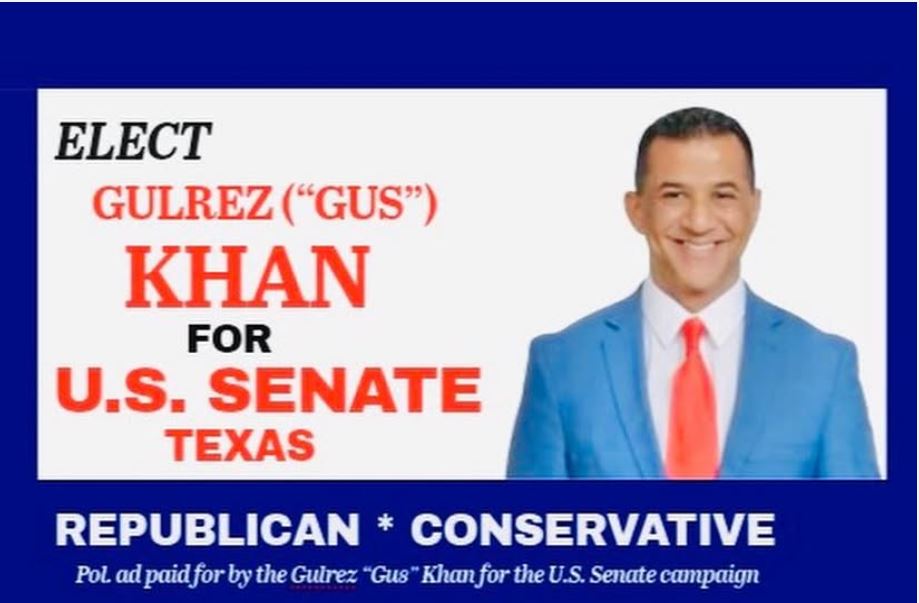
Join the Movement Put America First. Elect Gulrez “Gus” Khan for U.S. Senate.Contact: gkhan@gkhanforsenate.com, emma@gkhanforsenate.com
Pol. Ad paid for by the Gulrez “Gus” Khan for U.S. Senate 2026 campaign